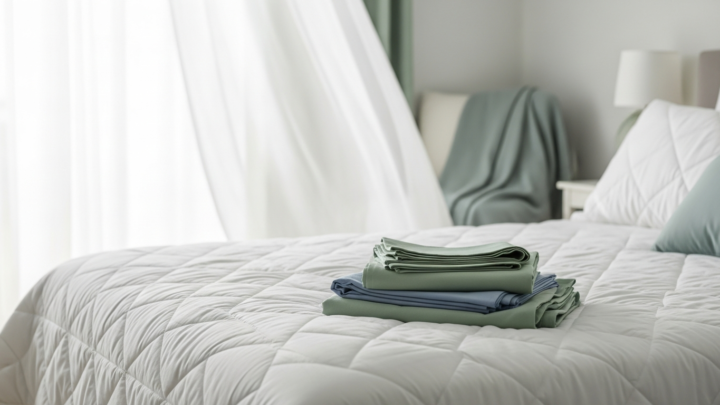
If your child wets the bed most nights, the part that can be most exhausting is the 2am strip-and-remake. The two-layer bed method is a straightforward setup that reduces the time between a wet bed and a dry one to under two minutes, without searching for spare sheets in the dark.
This is not a new idea, but it is underused. Once you have made the bed this way, you will not want to go back.
## What the Two-Layer Bed Method Actually Is
The principle is simple: you make the bed in two complete layers, one on top of the other. When the top layer is wet, you strip it off in one motion—waterproof pad, sheet, done—and the dry second layer underneath is already in place. No remaking. No fumbling with corners. Just straight back to sleep.
Each layer consists of:
– A waterproof mattress protector or bed pad laid flat
– A fitted or flat sheet on top of it
You stack: mattress → waterproof layer 2 → sheet 2 → waterproof layer 1 → sheet 1.
The child sleeps on sheet 1. If they wet, you remove sheet 1 and waterproof layer 1. Sheet 2 and waterproof layer 2 remain clean underneath. The mattress itself stays dry throughout.
## What You Need
### Two waterproof layers
Options include:
– Full fitted waterproof mattress protectors — these encase the mattress corners securely and are ideal for the bottom layer, providing a stable, reliable base. Terry towelling or quilted finishes tend to be quieter than crinkly PVC-backed versions.
– Waterproof bed pads or chair pads — flat, non-fitted pads that lie on top of the sheet, useful for the top layer because they are quicker to swap out. Look for ones with a non-slip backing or tuck-in flaps to prevent shifting during the night.
– Combination approach — many parents use a fitted protector as the base layer and a flat waterproof pad as the top layer, covering only the central sleeping zone, which is usually sufficient for overnight wetting.
### Two sets of sheets
You need two complete fitted or flat sheets per bed. Keep them washed and ready — the system only works if both sets are clean and available. Some families keep the second set folded in the child’s room to avoid searching during a night change.
### Optional additions
– Waterproof pillow protectors — worth adding if your child moves around a lot or wets heavily.
– Waterproof duvet cover — useful for children who wet under the covers, though for most children a bed pad is sufficient.
## How to Make the Bed
1. Put your waterproof mattress protector (layer 2) directly onto the mattress.
2. Put a fitted sheet (sheet 2) over it.
3. Lay a waterproof bed pad (layer 1) flat in the centre of the sheet, covering the area where your child sleeps—roughly hip to shoulder width.
4. Put the second fitted sheet (sheet 1) over everything.
5. Add pillow protectors under both pillowcases if using them.
The bed looks and feels like a normal made bed. Your child is not sleeping on a crinkly pad—they are sleeping on a regular sheet, with protection underneath they will not notice.
## How a Night Change Works
When your child wets:
1. Remove sheet 1 (the top sheet)—it pulls off like any sheet.
2. Remove the waterproof pad underneath it—one item, lifts off flat.
3. The clean sheet 2 is immediately underneath, already fitted and ready.
4. Put your child back into bed.
Total time: under two minutes if the layers are arranged properly. No lights-on search for sheets. No cold mattress. No fully awake child by the time you have finished.
The wet items go straight into a lined bin or waterproof bag by the door—do not put them in the washing machine at 2am. Deal with laundry in the morning.
## Does the Bottom Layer Actually Stay Dry?
Yes—provided the top waterproof layer is positioned well. Coverage is key. A bed pad that is too small for a heavy wetter may not contain everything, so match pad size to your child’s typical wetting volume. For heavier wetters, a full fitted protector as the top layer (rather than a flat pad) offers more reliable containment—the trade-off is slightly longer removal time.
If leaks frequently reach the second layer, the issue is more likely with the absorbent product your child wears than with the bed setup. Persistent leaks despite good protection are worth investigating—see [why overnight pull-ups leak](https://www.sleepsecurenights.com/category/bed-room-protection/mattress-protectors/) and [how to stop leg leaks in overnight pull-ups](https://www.sleepsecurenights.com/how-to-stop-leg-leaks-in-overnight-pull-ups-every-approach-that-actually-works/) for more details.
## Practical Tips That Make It Work Better
### Fit matters
Loose sheets bunch and shift. Well-fitted sheets on both layers keep everything in place. Deep-pocket fitted sheets are worth the extra cost for this reason.
### Use a consistent pad size
If your child is a restless sleeper, a larger pad provides more margin. A 75 x 90cm pad is adequate for most children; 90 x 90cm offers more coverage. Ensure the pad covers your child’s core sleeping area—if it slides to one side, it isn’t effective.
### Tuck or anchor the top pad
A flat waterproof pad without a non-slip surface may migrate during the night. Choose a pad with grip backing or tuck the edges under the mattress slightly. Some parents use a safety pin at each corner to secure it—quick to release but stays in place overnight.
### Have a wet bag or lined bin in the room
A dedicated bag for wet items allows quick disposal. Washable, sealable wet bags contain odour and are neater than open baskets. This small addition reduces disruption during night changes.
### Keep a spare nightwear set in the room
Having a folded spare pyjama set ready on the child’s shelf or door handle makes the change quick. No need to search wardrobes or drawers.
## What About Bunk Beds?
The two-layer method works on bunk beds, though fitting a bottom layer on an upper bunk is more challenging due to the safety rail. A practical workaround: use a full fitted waterproof protector on the upper bunk mattress as the base layer, and only add a flat pad plus sheet as the top layer. You still strip one item instead of remaking, which is a significant improvement over a single-layer setup even if the lower layer is harder to refresh.
## For Families Doing Multiple Changes Per Night
If your child wets more than once, two layers may not suffice. Some families use three layers—base protector, sheet, pad, sheet, pad, sheet—allowing two complete changes before laundry. This setup is more involved but can be useful for children with high-frequency wetting or during difficult periods.
[Night changes](https://www.sleepsecurenights.com/category/night-management/night-changes/) are one part of managing bedwetting. If the process is exhausting, [how other parents manage night changes without burning out](https://www.sleepsecurenights.com/i-am-exhausted-from-night-changes-how-other-parents-manage-without-burning-out/) offers strategies. For broader support, [managing bedwetting stress as a family](https://www.sleepsecurenights.com/managing-bedwetting-stress-as-a-family-what-really-helps/) is recommended.
## Setting Up the Two-Layer Bed Method Tonight
The two-layer bed method requires two waterproof layers and two sets of sheets—most families already own at least one waterproof protector, so the additional items are a pad and an extra sheet set. The setup takes about ten minutes once, then it runs itself.
If you regularly change sheets at night and haven’t adopted this system, now is a good time to start. Strip the bed, layer it properly, and the next wet night will be less disruptive for you and your child.