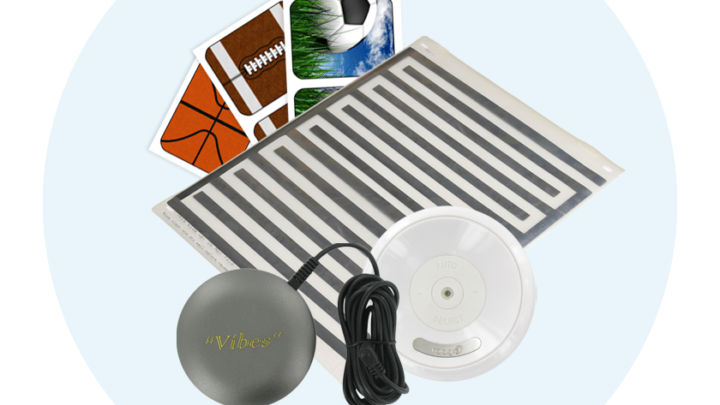
Bedwetting alarms work by detecting moisture and triggering a response that either wakes a child or conditions the brain over time to respond to a full bladder. For hearing children, that response is usually sound — a loud buzzer or chime. For deaf children, or those with significant hearing loss, that approach simply does not work. The good news is that bedwetting alarms for deaf children do exist, and several designs address the problem effectively using vibration, light, or a combination of both.
This article explains how these alternatives work, what to look for, and what to be realistic about before you buy.
## Why Standard Bedwetting Alarms Do Not Work for Deaf Children
Most bedwetting alarms rely entirely on sound. The sensor detects the first drops of urine and triggers a loud alarm — typically 70 to 90 decibels — designed to rouse even a deep sleeper. If a child cannot hear that alarm, or uses a hearing aid they remove at night, the signal never reaches them.
This is not a niche problem. Around 1 in 1,000 children in the UK is born with permanent hearing loss, and many more have partial or fluctuating loss due to glue ear or other conditions. Assuming that sound-based tools are universal creates a straightforward access barrier — one that is entirely solvable with the right equipment.
## The Two Main Alternatives: Vibration and Light
### Vibration Bedwetting Alarms
A vibrating alarm works by placing a small receiver — often a disc or wristband — on or near the child’s body. When the moisture sensor detects urine, it sends a wireless signal to the vibrating unit, which shakes strongly enough to wake a sleeping child. The vibration is the primary alert, with sound often included for a parent or carer monitoring nearby.
**Key features to look for:**
– **Vibration strength:** Should be sufficiently powerful to wake a deep sleeper. Some units are noticeably stronger than others — check independent reviews rather than manufacturer descriptions.
– **Wearable vs under-pillow:** Wristband-style vibrators stay in contact with the body during position changes; under-pillow units can shift during the night. Both options exist — consider your child’s sleep style.
– **Wireless range:** If a parent also needs to be alerted (for example, for younger children or those who need support), check that the range covers your home layout.
– **Separate parent receiver:** Some systems include a second unit that vibrates or sounds an alert in the parent’s room.
Vibrating alarms are the most direct substitute for sound-based models. A child with profound deafness who sleeps with a vibrating band on their wrist has the same functional chance of being woken as a hearing child with an audible alarm.
### Light-Based Bedwetting Alarms
Light-flash alarms trigger a bright, rapid strobe or flash when moisture is detected. These work best when the light source is positioned where the child will see it — which requires the child to be facing the device and not completely buried under covers. This is a more situational solution than vibration.
Light alerts are sometimes used in combination with vibration to provide two simultaneous signals. In practice, light-only alarms are less commonly used for bedwetting than vibration, partly because position and bedding make visual alerts unreliable at night.
However, for children who are both deaf and have tactile sensitivities — a combination that appears with some frequency in children with complex needs who may already be known to a bedwetting clinic — light can sometimes serve as a secondary prompt or as part of a room-based alert system.
## Combined Systems: Bell-and-Pad with Wireless Vibration
Some families use a two-part approach: a standard bed sensor (the pad-style that sits under the sheet) paired with a wireless transmitter that sends the signal to a separate vibrating unit. This removes the wearable sensor from the child entirely — which matters for children who find body-worn devices uncomfortable — while still delivering a tactile alert.
These systems tend to be used in clinical settings and are sometimes available on NHS prescription for children with additional needs. A continence nurse or paediatrician can advise on referral routes and whether equipment loan schemes apply in your area.
## What the Evidence Says About Alarm Therapy Generally
Bedwetting alarms are one of the most evidence-backed interventions for nocturnal enuresis. A Cochrane review of alarm therapy found success rates (14 consecutive dry nights) of around 65–70% for children who complete a full course. This evidence base applies to the alarm principle — conditioning the brain to respond to a full bladder — not to the specific modality used to deliver the alert.
There is no specific controlled trial evidence for vibrating or light-based alarms in deaf children. However, the mechanism is the same: the child needs to be consistently woken at the point of wetting so that, over weeks, the response becomes automatic. If the alert reliably wakes the child, the modality should not affect outcomes.
The practical implication: if a vibrating alarm wakes your child consistently in the first week, that is a good sign. If after 10 to 14 nights the child is sleeping through the vibration on most occasions, the alert may not be strong enough. Consider a more powerful unit or different positioning before concluding that alarm therapy does not work. If previous attempts have failed, see [this guide on next steps when alarms have not worked](https://www.sleepsecurenights.com/we-have-tried-two-different-alarms-and-neither-has-worked-what-comes-next/).
## Specific Products Available in the UK
Product availability varies, so treat this as a starting point rather than an exhaustive list. Always verify current options before purchasing.
– **Ramsey Alarm (Malem with vibration):** Malem produce a vibrating alarm in their wearable range. Widely used in NHS services and well-evidenced in the UK.
– **DRI Sleeper Eclipse:** A wireless system with a separate vibrating wristband receiver, used for both hearing and deaf children.
– **Rodger Wireless:** A wireless sensor worn in pants with a vibrating wristband receiver, suitable for children who move during sleep.
– **Enurella / generic combined units:** Various import options at lower prices, with variable quality.
If your child has an Education, Health and Care Plan (EHCP) or is known to a specialist continence service, ask about equipment loan or prescription routes before buying privately.
## Considerations for Children With Additional Needs
Deaf children often have other conditions affecting bedwetting management — including ADHD, autism spectrum conditions, and neurological differences. These can influence both the frequency of bedwetting and response to alarm therapy.
For children with sensory sensitivities, the vibrating unit can cause distress — due to sensation, novelty, or association with wetting. Gradual desensitisation (practising wearing and triggering the alarm during the day) can help. Strategies for children who sleep through or disengage from alarms are also applicable, adapted for vibration.
For some children, especially where distress around wetting is primary, the most effective short-term approach may be reliable overnight protection rather than conditioning. Managing bedwetting stress as a family is a valid goal alongside or before treatment, not a fallback.
## When to Involve a Specialist
If your child is deaf and experiencing bedwetting, a GP referral to a paediatric continence service is recommended. Bedwetting in deaf children is not inherently more complex, but specific access requirements around alarm equipment may necessitate specialist advice.
A continence nurse can:
– Assess whether alarm therapy is suitable based on age, wetting pattern, and diagnoses
– Identify available equipment on loan or prescription
– Support the full alarm programme (usually 12–16 weeks)
– Advise on combination approaches if needed
If your GP hesitates to refer, use [this guide on requesting a referral](https://www.sleepsecurenights.com/the-gp-said-just-wait-and-see-but-my-child-is-ten-what-to-say-to-get-a-referral/).
## Making the Decision
Bedwetting alarms for deaf children are a practical, effective intervention — not a compromise. Vibrating systems deliver the core conditioning mechanism through a different sensory channel, and several products are available in the UK, including via NHS routes.
Key steps: ensure the alert is strong enough to wake your child consistently, trial during the day if sensory tolerance is uncertain, and involve a continence nurse if additional needs or access to equipment are concerns. NHS support is often available, so private purchase is not always necessary.