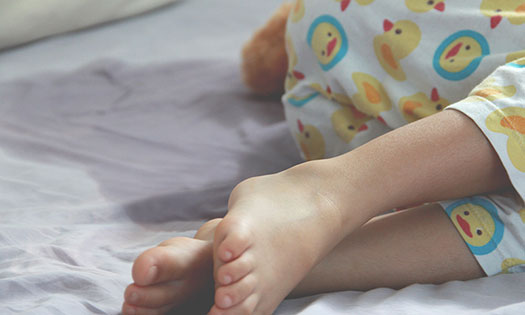
If your child wets the bed most nights and nothing you’ve tried has made a difference, one important question to ask is: when did they last have a proper bowel movement? Constipation and bedwetting are connected more often than many parents realise — and it’s one of the most commonly overlooked reasons why standard treatments don’t work.
## Why Constipation Affects Bladder Control at Night
The bladder and the bowel sit very close together in the pelvis. When the rectum is full or chronically stretched with stool, it presses directly against the bladder. This pressure reduces bladder capacity — meaning less urine can be stored before the bladder signals it needs to empty — and can also disrupt the nerve signals that coordinate bladder control during sleep.
Research published in the journal *Pediatrics* and elsewhere consistently shows that resolving constipation leads to significant improvement in bedwetting in many children. One well-cited study found that treating constipation alone resolved bedwetting in around one-third of children without any other intervention. This highlights that some children who have been trialling alarms, fluid restriction, and reward charts may actually have a digestive issue at the root.
For a fuller understanding of the physiological mechanisms behind bedwetting, see [What Really Causes Bedwetting? A Parent’s Guide to the Science](https://www.sleepsecurenights.com/what-really-causes-bedwetting-a-parents-guide-to-the-science/).
## The Problem With “Not Constipated”
Most parents say their child isn’t constipated because they are passing stool regularly. However, constipation in children is often not about frequency alone. A child can have daily bowel movements and still have a rectum that is chronically distended from retained stool that hasn’t fully cleared.
This condition is sometimes called *faecal loading* — where a backlog of stool stretches the rectum over time, reducing its sensitivity. Children with faecal loading may not feel the urge to go because their rectum has adapted to being full. They might pass small, frequent stools that look normal but are actually overflow around an impacted mass.
### Signs Constipation May Be Contributing
– Hard, pellet-like stools or those requiring straining
– Infrequent bowel movements (fewer than three per week), or very frequent small stools
– Avoidance of the urge to go or holding on for extended periods
– Stomach ache, especially in the lower abdomen
– Soiling (overflow incontinence), with liquid stool leaking around impacted stool
– A firm, distended lower abdomen on palpation
– Daytime wetting alongside night wetting — often indicating physical bladder capacity issues
If daytime symptoms are present with night wetting, see [My Child Is Wetting During the Day as Well: How Daytime and Nighttime Wetting Relate](https://www.sleepsecurenights.com/my-child-is-wetting-during-the-day-as-well-how-daytime-and-nighttime-wetting-relate/).
## Why This Gets Missed
Constipation in children is often underdiagnosed. Parents may not monitor bowel habits closely or may not recognise discomfort, as it can become normal for the child. Additionally, during short GP appointments focused on bedwetting, bowel history may not be discussed.
The link between constipation and bedwetting isn’t always obvious, especially if a child appears to pass stool regularly. While some GPs and paediatricians are aware of the connection and will ask about bowel habits, not all do.
If you feel your concerns haven’t been fully explored, see [The GP Dismissed Our Bedwetting Concern: What Parents Can Do When They Are Not Heard](https://www.sleepsecurenights.com/the-gp-dismissed-our-bedwetting-concern-what-parents-can-do-when-they-are-not-heard/).
## How Constipation Is Assessed and Treated
If you suspect constipation, the first step is to discuss it with your GP. Diagnosis is usually based on history, symptoms, and sometimes abdominal examination. An X-ray may be used to assess faecal loading but isn’t routine.
### NICE Guidance on Childhood Constipation
NICE guidelines (CG99) recommend a stepped approach. The first-line treatment is typically an osmotic laxative such as *Movicol Paediatric Plain* (macrogol), sometimes in a higher “disimpaction” dose to clear the backlog before moving to a maintenance dose. This is a prescription medication, though Movicol is also available over the counter in standard doses.
Treatment often needs to continue for several months — enough for the rectum to return to normal size and sensitivity. Parents often stop treatment too early, which can lead to recurrence of constipation and associated bedwetting.
### Dietary and Fluid Changes
Alongside laxatives, practical changes can support progress:
– **Adequate fluid intake** — dehydration makes stool harder and more difficult to pass. Restricting fluids in children with bedwetting can worsen constipation.
– **Fibre** — fruit, vegetables, wholegrains, and legumes support regularity. Gradually increasing fibre intake with adequate fluids is advisable.
– **Toilet routine** — sitting on the toilet after meals (especially breakfast and dinner), with feet supported on a step so knees are above hip height, utilises the gastrocolic reflex and facilitates passing stool.
– **Avoiding straining** — children who strain often may need posture support and reassurance rather than increased effort.
## What to Expect Once Constipation Is Treated
Improvement in bedwetting, if caused by constipation, usually occurs over weeks to months. The rectum needs time to decompress and return to normal. During this period, maintaining other routines and protective measures is sensible.
Not all cases of bedwetting linked to constipation resolve completely after bowel function improves. Some children have multiple factors, including sleep arousal difficulties, lower overnight ADH hormone levels, or independent bladder capacity issues. Treating constipation removes one variable but may not resolve all issues.
If bedwetting persists despite good bowel management and other interventions, see [We Have Tried the Alarm, Desmopressin, Lifting and Nothing Has Worked: Next Steps](https://www.sleepsecurenights.com/we-have-tried-the-alarm-desmopressin-lifting-and-nothing-has-worked-next-steps/).
## A Note for Children With ADHD, ASD, or Sensory Sensitivities
Children who are neurodivergent or have sensory processing differences are at higher risk of constipation for various reasons. They may avoid using school toilets, resist dietary changes, or not register bodily cues, including the urge to defecate. Habitual withholding may also be entrenched.
In these cases, managing constipation often requires a more gradual, supported, and flexible approach. A specialist such as a continence nurse or paediatric gastroenterologist may be more helpful than a standard GP. If a referral hasn’t been offered, consider requesting one.
## What to Do Right Now
If bowel habits haven’t been discussed with your GP in relation to bedwetting, this is a crucial next step. Be prepared with a brief history: frequency and consistency of stools (using a stool chart can help), any pain or avoidance, and whether daytime wetting is also present.
If constipation is confirmed, commit to the full treatment plan, including maintenance. Continue protective products and routines while the bowel function improves. Managing practical routines and addressing underlying causes are both important.
While constipation and bedwetting don’t always occur together, when they do, treating bowel issues is often the most effective and overlooked intervention. It’s worth investigating before assuming the problem is more complex.