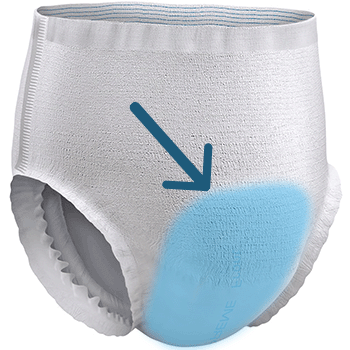
If you’re looking at the [Molicare Slip Maxi](https://www.sleepsecurenights.com/molicare-pad-mini-booster-review/), you’ve already done the groundwork. You know standard pull-ups aren’t sufficient, and you need something with serious overnight capacity. This review covers what the Molicare Slip Maxi delivers, where it performs well, its limitations, and who it’s best suited for — without padding.
## What Is the Molicare Slip Maxi?
The Molicare Slip Maxi is a taped brief (sometimes called a nappy or all-in-one) made by Hartmann, a German medical products company. It sits at the top of the Molicare Slip range in terms of absorbency, above the Light, Medium, and Plus variants. It is used across continence care settings—including NHS prescribing—but is also available for purchase directly as a consumer product.
It uses a traditional taped fastening rather than a pull-up format, which is relevant both for performance and for how it’s fitted and changed. More on that below.
## Molicare Slip Maxi: Key Specifications
### Absorbency
The Maxi variant is rated at approximately 3,400–3,600 ml depending on size, using the ISO 11948-1 rewet test. In plain terms, this is among the highest-absorbency products available in the taped brief format for this size range. For context, most children’s pull-ups (including [Drynites](https://www.sleepsecurenights.com/category/products/drynites/)) are rated between 600–1,000 ml. The difference is substantial.
That said, ISO lab ratings don’t directly translate to real-world performance. A product that holds 3,400 ml under test conditions may behave differently when a sleeping child is lying on their side and the volume is released suddenly. For a deeper understanding of why this matters, [the physics of overnight leaking](#) explains how position affects absorption in practice.
### Sizes Available
– **Small (S):** Hip circumference 55–85 cm
– **Medium (M):** Hip circumference 75–110 cm
– **Large (L):** Hip circumference 100–150 cm
– **Extra Large (XL):** Hip circumference 130–170 cm
For children and young people, Small and Medium are most relevant. The Small fits many older children with a slimmer build. Always measure before ordering—poor fit is the most common cause of leaks regardless of absorbency rating.
### Core Design
The Slip Maxi uses a cellulose and SAP (superabsorbent polymer) core with a cloth-like outer cover. The inner acquisition layer is designed to pull fluid away from the skin quickly. It does not have standing leg cuffs like some infant nappies—the leg elastics are flat, which is a consideration for side sleepers prone to leg leaks.
## Who Uses the Molicare Slip Maxi?
The Molicare Slip Maxi is not marketed specifically at children; it’s a clinical continence product used across age groups. In practice, it is used for:
– Older children and teenagers with heavy or unpredictable overnight wetting where pull-up capacity is insufficient
– Children and young people with complex needs, [physical disabilities](https://www.sleepsecurenights.com/category/special-needs/physical-disabilities/), or autism where taped briefs are easier to manage or preferable on sensory grounds
– Teenagers and adults who require the highest overnight containment
– Situations where a carer manages changes rather than the individual independently
For parents concerned about sensory sensitivities, the cloth-like outer is generally quieter and softer than some alternatives. Texture and noise are legitimate factors—if the product is rejected because it’s uncomfortable, it’s the wrong product regardless of its specifications.
## Taped Brief vs Pull-Up: Does the Format Matter?
Yes, significantly. A taped brief is applied lying down and fastened with resealable adhesive tabs at the hips. This has practical implications:
– It cannot be pulled on or off like underwear, which matters for independent toileting.
– It generally provides a more secure fit around the waist and legs than a pull-up.
– For children who can use the toilet overnight, it means either removing the entire brief or accepting that it stays on through any nighttime toilet trips.
– For children not toileting independently overnight, the format is less relevant to dignity and offers better containment.
The stigma around taped briefs—that they are less appropriate than pull-ups for older children—is not justified by evidence. If a product works and the child is comfortable, format is a practical consideration, not a moral one. For more on this, [this piece on nappy core vs pull-up format](#) explains the engineering trade-offs.
## Performance: What Parents and Carers Report
Based on feedback from forums, review sites, and continence care communities:
### What Works Well
– High overnight capacity—most users can hold heavy wetting through the night
– Skin stays drier than with lower-absorbency products due to the acquisition layer
– Resealable tabs allow repositioning before fastening
– Cloth-like outer is generally acceptable for sensitive skin
– Available in a range of sizes suitable for larger or older children
### Limitations
– Flat leg elastics, not cuffed—side sleepers with rapid voiding may experience leg leaks
– Noticeable bulk, inherent to the high absorbency level
– Not suitable for independent toileting without assistance
– Some users find the tabs stiff initially—proper positioning before fastening is important
If leg leaks at night are a primary concern, understanding what causes them before choosing a product is advisable. [Leg leaks at night are the most common complaint for a reason](#)—and the solution isn’t always more absorbency.
## Where to Buy and Cost
The Molicare Slip Maxi is available through:
– Hartmann (molicare.co.uk)
– Amazon
– Pharmacy and medical supply retailers
– NHS prescription (for eligible patients—consult your GP or continence nurse)
Prices vary, typically around £15–£25 for a pack of 20–24, depending on size and supplier. Bulk buying reduces unit cost. If your child qualifies for NHS-prescribed products, the Molicare Slip Maxi is often on NHS formularies—ask your healthcare provider.
## Comparison Within the Molicare Slip Range
Hartmann offers four absorbency levels:
– **Molicare Slip Light:** ~800 ml—suitable for light overnight wetting
– **Molicare Slip Medium:** ~1,900 ml—moderate overnight use
– **Molicare Slip Plus:** ~2,800 ml—heavy overnight wetting
– **Molicare Slip Maxi:** ~3,400–3,600 ml—maximum capacity, focus of this review
If the Maxi exceeds your needs, the Plus is a reasonable alternative with less bulk. For uncertain cases, start with the Maxi for overnight use—under-absorbency can cause leaks and sleep disturbance; over-absorbency leads to bulk, which is less problematic.
## NHS Prescription Availability
The Molicare Slip range appears on many NHS Drug Tariff and local formularies for continence products. Eligibility and prescribing depend on clinical assessment, typically for children aged five and over with diagnosed nocturnal enuresis or continence issues.
Ask your healthcare provider if this product can be prescribed. If facing obstacles, [this guide on what to do when your GP dismisses your bedwetting concerns](#) may help.
## Sensory and ASD Considerations
For children with autism or sensory processing differences, product texture, sound, and fit are important. The Molicare Slip Maxi’s cloth-like outer is quieter than plastic-backed options. Its bulk may be positive or negative depending on the child’s preferences.
Sampling before committing is advisable—Hartmann offers samples via their website.
## Final Assessment
The Molicare Slip Maxi is among the most capable overnight containment products available in the UK. Its high absorbency, positive user feedback, and availability through retail and NHS routes make it a strong choice.
Ideal for situations where pull-up products have failed, where a carer manages changes, or where maximum capacity is needed for comfort and sleep quality. If leg leaks persist despite using the Maxi, the issue likely relates to core placement or sleep position rather than absorbency—worth exploring separately.
For further understanding of why pull-up products often underperform at night, see [this overview of the overnight pull-up design problem](#).