The Night Guard bedwetting alarm is one of the most frequently searched products in the UK bedwetting alarm market, yet reliable, unbiased information about it is surprisingly hard to find. If you are trying to work out whether it is worth buying — and how it compares to alternatives — this article provides a clear overview.
## What Is the Night Guard Bedwetting Alarm?
The Night Guard is a wearable bedwetting alarm produced by Rodger Wireless, a Finnish company that has manufactured enuresis alarms since the 1990s. It is sold in the UK under various retailer listings, sometimes branded simply as “Night Guard” and sometimes as part of the broader Rodger Wireless range.
The device operates on the same principle as all bedwetting alarms: a moisture-sensing element detects urine at the first drop, triggers an alert, and wakes the child so they can stop voiding, go to the toilet, and — over weeks of consistent use — begin to condition a response that becomes automatic during sleep.
### How the Night Guard Is Worn
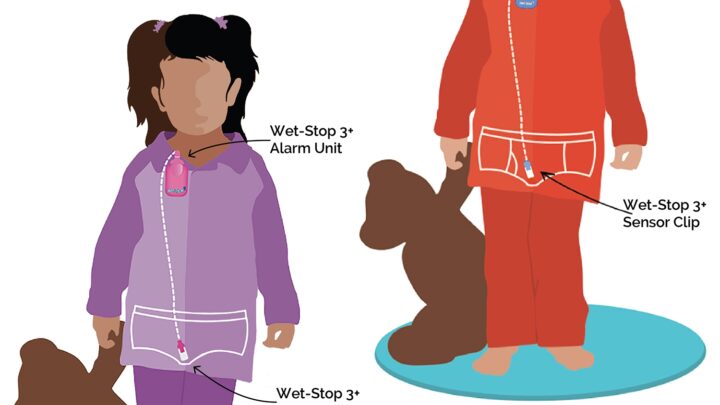
Unlike clip-on alarms that attach to underwear or pyjamas, the Night Guard uses a small sensor embedded in specially designed underpants with sensing threads. The alarm unit itself is wireless and can be worn on the wrist or placed on a bedside surface. Because there is no cable connecting sensor to alarm, there is less risk of tangling, and the setup tends to be more comfortable for children who find wired devices intrusive.
The pants come in several sizes and are reusable, though they need replacing when worn out. Replacement pants are available separately.
## Night Guard Alarm: Key Specifications
– **Detection method:** Integrated textile sensor in alarm pants — no separate clip or snap sensor
– **Alert types:** Sound, vibration, or both
– **Wireless range:** Typically up to 30 metres, depending on walls and interference
– **Receiver options:** Wrist-worn unit or bedside receiver; some kits include both
– **Volume:** Adjustable; the wrist unit vibration can be used as a quieter alert
– **Power:** USB rechargeable (check current listing)
– **Sizes:** Available from approximately age 4–5 up to adult sizes
## How the Night Guard Compares to Other Bedwetting Alarms
There are three main types of bedwetting alarm available in the UK: clip-on wired alarms, clip-on wireless alarms, and textile-integrated alarms. The Night Guard falls into the third category.
### Night Guard vs Clip-On Wired Alarms (e.g., Malem, Chummie)
Wired alarms attach a small sensor to underwear, with a wire leading to an alarm unit on the pyjama top or wristband. They are generally the most affordable and have a long clinical track record — Malem, in particular, is well-evidenced. The Night Guard’s advantage is comfort and simplicity: no wire to clip, no sensor to attach each night. The downside is cost — the Night Guard starter kit is more expensive, and it requires proprietary pants.
### Night Guard vs Clip-On Wireless Alarms (e.g., DRI Sleeper Excel)
Wireless clip-on alarms eliminate the wire but still require a separate sensor attached to underwear. The Night Guard embeds the sensor into the fabric itself, removing the attachment step. For children who resist nightly setup routines or have sensory sensitivities, this design can be more acceptable. However, it is not compatible with nappies or pull-ups, which some children use.
### Night Guard vs Bed-Based Alarms (e.g., Rodger Mat)
Bed-based alarms use a mat placed under the sheet, requiring no wearable component. They are suitable for younger children or those resistant to wearing anything. Detection may be slower as urine needs to reach the mat, whereas the Night Guard detects moisture at the body, offering faster response. If speed is a priority, a wearable alarm generally has an advantage.
## What the Evidence Says About Bedwetting Alarms
NICE guidance supports bedwetting alarms as a first-line treatment for nocturnal enuresis in children aged seven and over, where behavioural measures alone have failed. A Cochrane review found that alarm treatment achieves dryness in about two-thirds of children who complete a full course, typically 8–12 weeks. Relapse rates after stopping are lower than with medication alone, especially when a structured overlearning programme follows initial success.
The evidence pertains to alarm therapy as a whole, not specific brands. There is no published head-to-head data comparing the Night Guard with other alarms. Compliance and consistency are more important than brand choice — an alarm that the child will wear every night is more effective.
For more background, see [My Child Sleeps Through the Bedwetting Alarm: Every Strategy That Can Help](https://www.sleepsecurenights.com/my-child-sleeps-through-the-bedwetting-alarm-every-strategy-that-can-help/).
## Who the Night Guard Is Best Suited To
– Children who resist nightly sensor attachment — the integrated design removes this friction point
– Sensory-sensitive children — no clip, no wire, no snap sensor against the skin
– Families wanting a wireless setup — the receiver can be placed in a parent’s room
– Children who are mobile sleepers — no cable to tangle during the night
– Older children and teens — adult sizing available, discreet wrist unit
## Who Might Be Better Served by a Different Alarm
– Children using nappies or pull-ups overnight — textile sensor pants are incompatible with absorbent products
– Families on a tight budget — clip-on wired alarms start from around £30–£50; the Night Guard kit is more expensive
– Children who have tried alarms without success — switching brands is unlikely to change outcomes; compliance or sleep depth are usually the limiting factors
– Very young children (under 5–6) — alarm therapy is generally not recommended before age 5; NICE guidance targets children aged 7+
If you have already tried alarm therapy without success, see [We Have Tried Two Different Alarms and Neither Has Worked: What Comes Next](https://www.sleepsecurenights.com/we-have-tried-two-different-alarms-and-neither-has-worked-what-comes-next/).
## Practical Considerations Before Buying
### Cost and Ongoing Expenses
The Night Guard starter kit includes alarm pants and a receiver. Replacement pants add to long-term costs. Starting with a lower-cost wired alarm can be a good initial test of the method.
### False Alarms
All alarms can trigger falsely, especially due to sweat in warm weather or active sleep. Textile sensors may have different sensitivity profiles. If false alarms are frequent, see [The Bedwetting Alarm Keeps Triggering for Sweat: How to Stop False Alarms](https://www.sleepsecurenights.com/the-bedwetting-alarm-keeps-triggering-for-sweat-how-to-stop-false-alarms/).
### Managing Noise at Night
The wireless design allows placement of the alarm in a parent’s room, helpful for deep sleepers or when minimizing disturbance to siblings. Over time, the goal is for the child to respond independently. See [The Alarm Is Waking Everyone in the House Except My Child: What to Do](https://www.sleepsecurenights.com/the-alarm-is-waking-everyone-in-the-house-except-my-child-what-to-do/).
## The Night Guard and Children Who Wet Heavily
Alarms are most effective when they trigger early, before a large volume of urine is released. In cases of heavy wetting during deep sleep, alarms may not prevent wetting but still support long-term conditioning. During treatment, using mattress protectors and waterproof bed pads is advisable to manage practical concerns.
## Should You Choose the Night Guard?
The Night Guard is a well-designed, genuinely wireless option suitable for children resistant to traditional clip-on devices. Its main limitations are cost and incompatibility with nappies or pull-ups, due to proprietary pants.
If your child is willing to wear the sensor pants and you have the budget, it is a valid choice. For those starting out or unsure about the approach, a lower-cost alarm can be a sensible way to test the method.
Most programmes require at least eight weeks of nightly use. If progress stalls, it is often due to sleep depth or compliance issues, not the device itself. For guidance on stalled therapy, see [We Have Used the Bedwetting Alarm for Eight Weeks and Nothing Has Changed](https://www.sleepsecurenights.com/we-have-used-the-bedwetting-alarm-for-eight-weeks-and-nothing-has-changed/).